Tajikistan in the “Kingdom of Carved Wood”
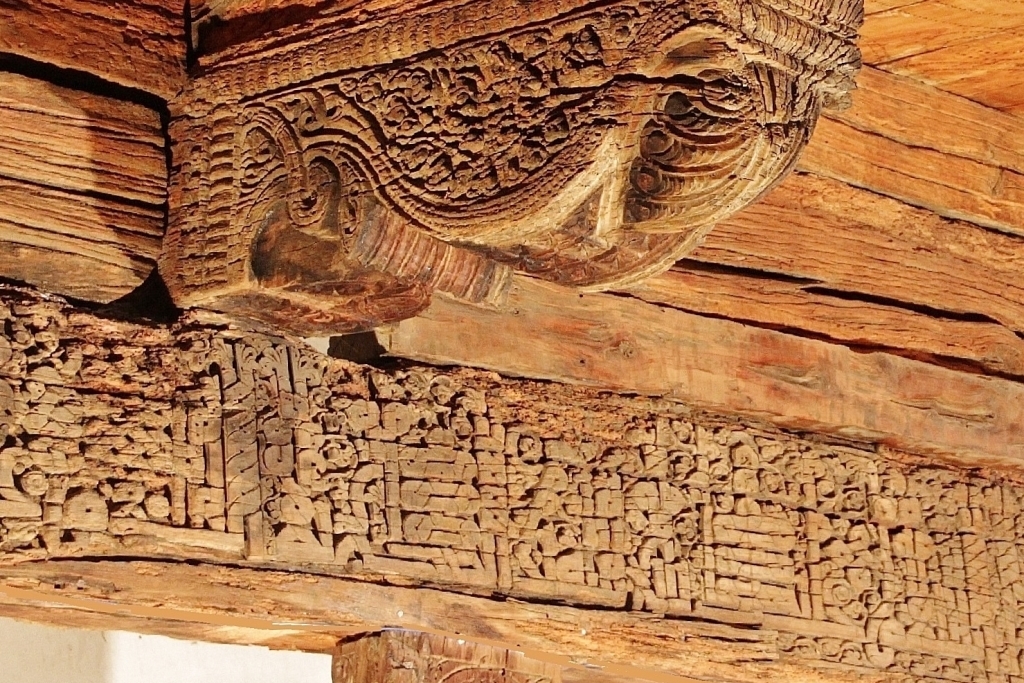
In the 1920s, during a scientific expedition to the mountainous regions of Upper Zeravshan, the renowned researcher of Central Asian history, Mikhail Andreev, discovered highly artistic samples of carved wooden columns and consoles from the 10th-12th centuries, which led him to call this valley the «Kingdom of Carved Wood.»
Later, this title was confirmed by the discovery of new masterpieces: columns, mihrabs, and even an entirely wooden mausoleum. Therefore, a century after that 1925 expedition, we can acknowledge that Tajikistan ranks first in the region for its preserved ancient samples of skillful wood carving.
Wood as a building material has always been highly valued in the forest-poor Central Asia. Wooden house constructions—columns, pillars, beams—constituted an interconnected, seismically resistant, load-bearing framework. But besides purely utilitarian functions, wood, thanks to carved decor, became an important means of artistic and aesthetic influence on people.
Sculptures were carved from wood, multi-story reliefs were created, and the structural elements of houses and religious buildings were lavishly covered with pictorial and ornamental carvings.
Ancient samples of wood carving have survived to this day, no younger than the 9th-10th centuries. The population treated ancient carved structures with care, as sacred attributes that once adorned revered temples, holy mausoleums, and mosques.
The decorative treatment of wood is also driven by the desire to demonstrate the ideological status of a building if it is a temple or mosque; the status of the owner if it is a palace or residential house, and the abundance of decor is an act of wishing well-being and prosperity to the inhabitants of the house.
Columns, according to Indo-European mythology, were perceived as a connecting axis between worlds.
According to the theory of the Renaissance scholar L. Alberti, the first columns were made in «human likeness: head, torso, legs.» Pamir craftsmen also correlated parts of columns with the human body: the capital with the head-sitangal (literally «head of the column») or «pehoni» (forehead), the trunk corresponded to the term «tana» — body, and the base «poth» — legs.
The main pillar-shokhsutun, or khasitan, stood out in particular. All five pillars in the house corresponded to sacred persons.
Archaeologist B. Litvinsky writes about the anthropomorphization of the central pillar among Pamir people, «ascending to the ideas of the supporting pillar of the dwelling as an embodiment of Purusha (in the Rigveda, the primordial man — Purusha, from whose body parts the Universe is formed), or a typologically homogeneous character with him.»
From the depths of Eastern Iranian mythologyThanks to archaeological research of the 1930s-1980s, we have an idea of the art of wood carving of the 6th-8th centuries — the time of our Eastern Iranian ancestors. This is the period of the greatest flourishing of the Silk Road, linking the unique civilizations of the European and Near Eastern Mediterranean through Central Asia with the Far East.
Our ancestors, the Tokharistanis and Sogdians, who were called the «Phoenicians of the East,» played a significant role in the functioning of this trade and cultural bridge.
Researchers rightly note that in the early Middle Ages, all roads led not to Rome, but to Samarkand and Balkh. The Sogdians, as the main caravan drivers, penetrated deep into China, where they built temples, introduced new views, artistic styles in art and music. Back along these roads came technical innovations, cultural achievements, and creative ideas from China and India.
Thanks to extensive archaeological work carried out in ancient Penjikent and Shahristan in the 1950s-80s, fragments of carved wood, or rather samples that were preserved in case of fire, where wood burned without access to oxygen and turned into charcoal, were studied in detail.
At the Kala-i Kakhkakha (Shahristan) site, 200 charred fragments of a carved wooden arched tympanum were discovered, decorating the entrance to the palace with pictorial scenes and ornamental compositions. Archaeologists meticulously pieced together these fragments into compositions, revealing to us only a small glimpse through which we can see a small part of the once vast and highly accomplished art.
Particularly noteworthy is the rich decorative decoration of the ceremonial halls of ancient Penjikent. The tall four columns in the center of the hall, adorned with carved capitals, supported complex carved wooden ceiling structures, which represented various variations of a complex stepped wooden ceiling with a skylight at the top.
Into the construction of inclined trapezoidal boards, wooden female sculptures-caryatids and figures of deities were often integrated. Overall, a very harmonious, spacious, top-lit interior of the hall was created. The light brightly highlighted the structures of the upper part of the ceiling and the middle recessed area between the four columns and, reflected, reached the walls decorated with multi-story frescoes, filling the interior space with epic solemnity.
Later, this title was confirmed by the discovery of new masterpieces: columns, mihrabs, and even an entirely wooden mausoleum. Therefore, a century after that 1925 expedition, we can acknowledge that Tajikistan ranks first in the region for its preserved ancient samples of skillful wood carving.
Wood as a building material has always been highly valued in the forest-poor Central Asia. Wooden house constructions—columns, pillars, beams—constituted an interconnected, seismically resistant, load-bearing framework. But besides purely utilitarian functions, wood, thanks to carved decor, became an important means of artistic and aesthetic influence on people.
Sculptures were carved from wood, multi-story reliefs were created, and the structural elements of houses and religious buildings were lavishly covered with pictorial and ornamental carvings.
In ancient and medieval times, there were far more forest lands in the habitat of Tajiks and their ancestors than today, and the settled agricultural way of life near water sources allowed for the special cultivation of trees for construction. For instance, in the Pamirs, to this day, the boundaries of residential plots are densely planted with pyramidal poplars, used in future constructions.In urban centers, due to numerous reconstructions, later overlays, wars, civil strife, and fires, old wood has not been preserved, but in mountainous areas such as the upper reaches of Zeravshan, Yagnob, Darvaz, and the Pamirs, due to natural isolation, carved wooden structures and archaeological fragments have been found, giving an idea of the artistic traditions of this craft.
Ancient samples of wood carving have survived to this day, no younger than the 9th-10th centuries. The population treated ancient carved structures with care, as sacred attributes that once adorned revered temples, holy mausoleums, and mosques.
The decorative treatment of wood is also driven by the desire to demonstrate the ideological status of a building if it is a temple or mosque; the status of the owner if it is a palace or residential house, and the abundance of decor is an act of wishing well-being and prosperity to the inhabitants of the house.
Columns, according to Indo-European mythology, were perceived as a connecting axis between worlds.
According to the theory of the Renaissance scholar L. Alberti, the first columns were made in «human likeness: head, torso, legs.» Pamir craftsmen also correlated parts of columns with the human body: the capital with the head-sitangal (literally «head of the column») or «pehoni» (forehead), the trunk corresponded to the term «tana» — body, and the base «poth» — legs.
The main pillar-shokhsutun, or khasitan, stood out in particular. All five pillars in the house corresponded to sacred persons.
Archaeologist B. Litvinsky writes about the anthropomorphization of the central pillar among Pamir people, «ascending to the ideas of the supporting pillar of the dwelling as an embodiment of Purusha (in the Rigveda, the primordial man — Purusha, from whose body parts the Universe is formed), or a typologically homogeneous character with him.»
From the depths of Eastern Iranian mythologyThanks to archaeological research of the 1930s-1980s, we have an idea of the art of wood carving of the 6th-8th centuries — the time of our Eastern Iranian ancestors. This is the period of the greatest flourishing of the Silk Road, linking the unique civilizations of the European and Near Eastern Mediterranean through Central Asia with the Far East.
Our ancestors, the Tokharistanis and Sogdians, who were called the «Phoenicians of the East,» played a significant role in the functioning of this trade and cultural bridge.
Researchers rightly note that in the early Middle Ages, all roads led not to Rome, but to Samarkand and Balkh. The Sogdians, as the main caravan drivers, penetrated deep into China, where they built temples, introduced new views, artistic styles in art and music. Back along these roads came technical innovations, cultural achievements, and creative ideas from China and India.
Thanks to extensive archaeological work carried out in ancient Penjikent and Shahristan in the 1950s-80s, fragments of carved wood, or rather samples that were preserved in case of fire, where wood burned without access to oxygen and turned into charcoal, were studied in detail.
At the Kala-i Kakhkakha (Shahristan) site, 200 charred fragments of a carved wooden arched tympanum were discovered, decorating the entrance to the palace with pictorial scenes and ornamental compositions. Archaeologists meticulously pieced together these fragments into compositions, revealing to us only a small glimpse through which we can see a small part of the once vast and highly accomplished art.
Particularly noteworthy is the rich decorative decoration of the ceremonial halls of ancient Penjikent. The tall four columns in the center of the hall, adorned with carved capitals, supported complex carved wooden ceiling structures, which represented various variations of a complex stepped wooden ceiling with a skylight at the top.
Into the construction of inclined trapezoidal boards, wooden female sculptures-caryatids and figures of deities were often integrated. Overall, a very harmonious, spacious, top-lit interior of the hall was created. The light brightly highlighted the structures of the upper part of the ceiling and the middle recessed area between the four columns and, reflected, reached the walls decorated with multi-story frescoes, filling the interior space with epic solemnity.
Комментарии (0)